
What’s the Payback Period for Residential Solar Panels in Virginia?
 Matt Powers 4 min read
As we celebrate our 10th anniversary installing solar panels across Virginia, we thought we’d address the all-important question for homeowners wanting to go solar: “How long until the solar system pays for itself?”
While we firmly believe that solar is a great way to reduce your carbon footprint, we also understand that it needs to make financial sense for your household.
We install solar on homes in Virginia (and have since 2015), and thought we’d share our experience with payback periods in VA.
Understanding Solar Payback Periods
The “payback period” refers to how long it takes for your energy savings to equal your initial investment. We’re focusing on residential for this article, as commercial solar systems are more complex to model, but typically have even faster payback periods.
There are two main approaches to financing solar:
Cash Purchase: With a cash purchase, you’ll face a significant upfront cost but will eventually save substantially more over the system’s lifetime.
Solar Loans: With a loan, you may start saving immediately or shortly after installation, as your monthly loan payment is often less than or similar to your previous electric bill. However, the total savings over the system’s lifetime are usually significantly less than with a cash purchase due to interest payments. For the purposes of this article, we’re going to focus on cash purchases.
Solar Panels as a Home Investment
Unlike most home improvements, solar panels are a valuable asset that also saves you money. According to research from the Lawrence Berkeley National Laboratory, homes with solar panels sell for approximately 4% more than comparable homes without solar systems.
This means while a remodeled bathroom might improve your quality of life but not directly pay for itself, solar panels hold value as a home improvement AND generate ongoing savings through reduced electric bills.
Average Payback Periods for Residential Solar Panels
When we design solar systems, we typically see payback periods estimated between 9 – 12 years for cash-based sales. There are a lot of factors though, so don’t stop reading there:
What Affects the Payback Period?
Several variables influence how quickly your solar investment will pay for itself:
1. Total System Cost
The size and quality of your solar system will significantly impact your initial investment. While larger systems are more expensive, they benefit from economies-of-scale, and will produce more energy, at a lower relative cost.
Similarly, high-quality equipment & installation is important to ensure reliability, so additional costs don’t affect your investment down the road.
2. Electricity Savings Over Time
Higher utility rates mean higher potential savings. Virginia utilities have been implementing substantial rate increases recently, with Appalachian Power Company (APCo) raising rates by more than 46% since 2021. These rising costs make solar an increasingly attractive option as your savings grow alongside utility rate increases.
3. Solar Renewable Energy Credits (SRECs)
Virginia homeowners can earn SRECs for the clean energy their systems produce. With prices ranging from $28-33 per SREC over the last few years, these credits provide an additional income stream that helps shorten your payback period.
4. Financing Options
While the 30% residential solar tax credit ended in January 2026, Virginia homeowners now have access to solar leases and PPAs that can lower or eliminate upfront costs. The commercial tax credit (still available through at least 2027) allows leasing companies to offer competitive rates—often lower than your current utility bill—making solar accessible even without the residential credit.
5. System Orientation & Performance
How much electricity your system generates depends greatly on its exposure to sunlight. South-facing panels with minimal shading typically perform best, generating more electricity and leading to faster payback times.
Below is an example of a system with some minor shading oriented SW, versus the same design rotated due south:
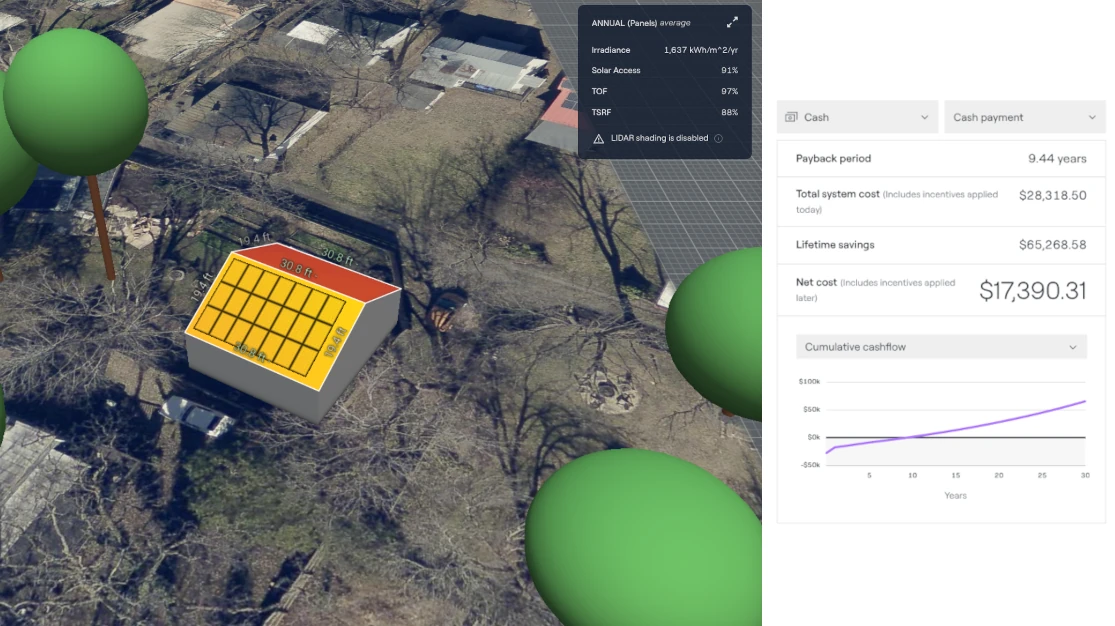 A system with minimal shade in Charlottesville (on Dominion Energy utility) is estimated at a 9.44 year payback, with almost 3x savings over its lifetime.
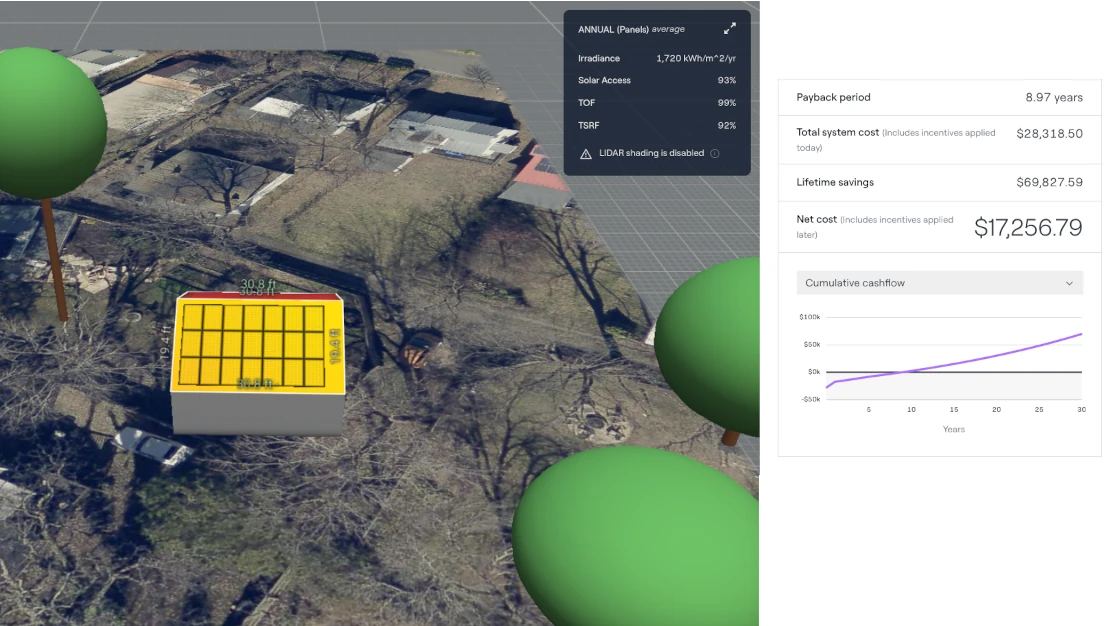 The same system, rotated 25 degrees due south, has higher performance, and lowers the payback period by about half a year.
The Bottom Line for Virginia Homeowners
For most residential solar systems in Virginia, we see estimated payback periods within 9-12 years. Considering that quality solar panels generally last 25-30 years, this means 15-20 years of essentially free electricity after reaching the payback period. Some utilities with higher rates can push the payback period even lower.
Ready to see what your specific payback period might be? Contact us for a free solar quote that takes into account your home’s unique energy use, site, and local utility rates.
Related Posts
Protect Your Solar Investment: A Guide to Understanding Solar Warranties
Learn about different solar warranties, what equipment is covered, and how to avoid unexpected costs after installing solar.
How to Lock In 25 Years of Low Energy Rates in 2026
Learn how Virginia homeowners can lock in 25 years of predictable energy costs with solar in 2026—including $0-down options now available!
What’s the best solar panel?
Take a deep dive into what makes a solar panel great, and learn how to get the best solar system for your home!