Skip to content
Residential solar installation in Virginia ready for a battery retrofit
Google
5.0 Rating (73)

Add a Battery to Your Existing Solar System

Adding battery backup to an existing solar system in Virginia is easier than ever — get a free retrofit quote.

Enphase
NABCEP
REC
BBB
Solar Insure Certified Provider

PDF or image, max 20 MB

No rip-and-replace, no inverter lock-in

Yes — you can absolutely add a battery to your existing solar.

If you put solar on your roof a few years ago and skipped the battery, the answer was probably: "They're expensive, finicky, and most of them don't quite make sense yet." That was our feeling at the time too. Battery technology has changed more in the last three years than it did in the previous twenty.

Modern home batteries are quiet, sealed, lithium iron phosphate (LFP) chemistry, with 15-year warranties and software that handles the hard parts in the background. For the vast majority of Virginia homes, adding a battery to an existing system is a clean, one-day-on-site retrofit — not the rip-and-replace project people imagine.

Get a free retrofit quote

Batteries that work with any inverter

You're not locked into one solar brand

Just because you have an Enphase system doesn't mean you have to buy an Enphase battery. While most manufacturers do offer batteries as well, in our opinion no single company is the best at everything. Modern batteries are inverter-agnostic — you can pair them with an existing solar system, regardless of brand or age.

My own house has Enphase microinverters on the roof — I picked them because they're extraordinarily reliable. But the battery in my garage is a FranklinWH aPower 2. The two systems work together seamlessly. (See our hands-on FranklinWH aPower 2 review for the long version.)

That's possible because the FranklinWH is AC-coupled — it connects on the AC side of your panel rather than tying into the DC side of your array. AC-coupled batteries work with virtually any solar setup:

  • Enphase (any generation — IQ6, IQ7, IQ8, even older M-series)
  • SolarEdge (with optimizers and standard inverters)
  • SMA Sunny Boy string inverters
  • Fronius string inverters
  • APsystems microinverters
  • Tesla solar inverters
  • Generac PWRcell systems
  • Older string inverters from ABB, Aurora, and other legacy brands

If your solar is producing well, there's no reason to throw it out just to get a battery. Keep what's working, add what you need.

A FranklinWH aPower 2 home battery alongside an existing solar inverter

Our recommendation

Why we recommend the FranklinWH aPower 2

We've installed batteries from most of the major brands over the years, and right now the FranklinWH aPower 2 is our default recommendation for retrofits. The short version of why:

  • 15 kWh of usable storage per battery — meaningful capacity, not just a bridge
  • 10 kW continuous, 15 kW peak — starts an HVAC compressor or well pump without flinching
  • 15-year warranty with strong end-of-warranty capacity guarantees
  • LFP chemistry — the safest, longest-lived chemistry in residential storage
  • Fan-less, sealed design — no noise, IP67, indoor or outdoor
  • Generator integration built in — the cleanest implementation we've seen
  • Stackable up to 15 units — start with one, add more later

It's not the only good battery on the market, but for retrofitting an existing solar system, the FranklinWH is hard to beat.

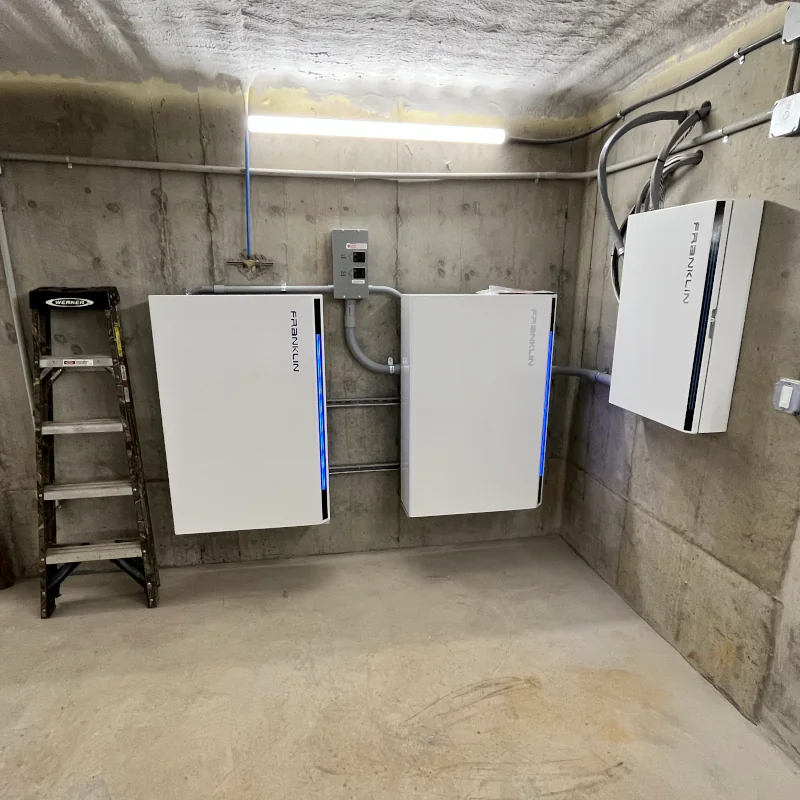
Stacked FranklinWH aPower 2 batteries installed in a Virginia basement

Get a free battery retrofit quote

Tell us a bit about your existing solar and what you'd like to back up. The more you can share, the faster we can get you a real number:

  • Your existing inverter brand and system size
  • What you'd like to back up — essentials or whole house
  • Typical outage duration where you live
  • Generator: have one, want one, or skip it
  • Future plans — EV, heat pump, system expansion

Free battery retrofit quote

PDF or image, max 20 MB

How much backup do you actually want?

This is the question that drives everything else. Before we can quote a battery retrofit, the most important conversation is about your goals. Most homeowners fall into one of three buckets:

Essentials backup

Typically 1 battery (15 kWh). Fridge, freezer, internet, lights, a few outlets, and one minisplit or furnace blower. Best for short-to-medium outages of 12–24 hours via a critical-loads sub-panel.

Whole-home backup

Typically 2 batteries (30 kWh). Backs up an entire 200-amp main panel, 20 kW continuous. AC keeps running, EV keeps charging, well pump keeps pumping. Most customers want this once they understand it's possible.

Multi-day resilience

3+ batteries, often paired with a propane or natural gas generator. The FranklinWH can charge from a generator — run it a few hours a day to top off, use battery the rest of the time. Quieter, less fuel.

Last thoughts on battery add-ons

Adding a battery to an existing solar system used to be a project. Now it's a product. The technology is mature, the warranties are long, the integration is genuinely easy, and you're not locked into anyone's ecosystem. If you've been holding off because it felt complicated, it might be time to revisit it and get a free battery quote. We've done a lot of these, and we'd be glad to help figure out if it's the right fit.

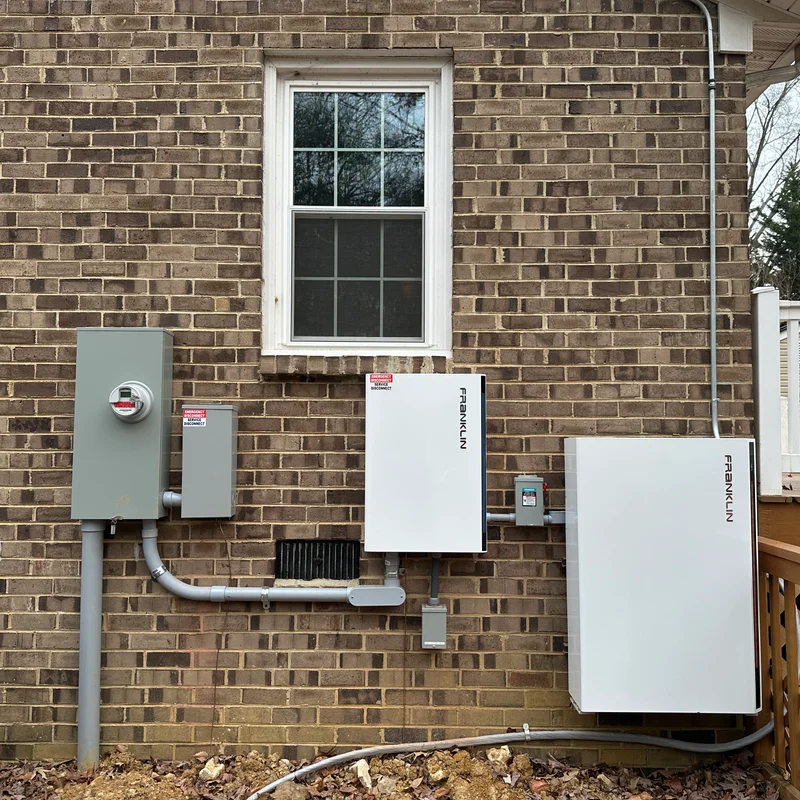
A FranklinWH aPower 2 battery and gateway providing whole-home backup in a Virginia garage
This battery-backup system provides power to the whole home. When the grid goes out, the gateway (center) disconnects from the grid, and allows the aPower 2 battery (right) to keep the lights and solar on.

Common questions about battery retrofits

Will adding a battery void my solar warranty?

No. AC-coupling the battery doesn't touch your solar inverter or panels — it ties into your home's main electrical panel. Your existing equipment warranties stay intact.

Do I need new permits?

Yes, but we handle them. A battery retrofit requires a building/electrical permit and an inspection from the local city or county.

How long does it take?

A typical battery-only retrofit is a one-day install once permits are approved. The full timeline from contract to powered-on is usually 4–8 weeks, mostly waiting on permits and utility approval.

Can I claim the federal tax credit on a battery retrofit?

The residential 30% federal tax credit (Section 25D) expired on December 31, 2025. Battery storage no longer qualifies for the residential credit on its own.

Will the battery pay for itself?

A common misconception in Virginia: batteries do not pay for themselves here. They provide energy security and functionality. Because we're fortunate to still have 1:1 net metering, there's no purely financial benefit to adding storage. What you get is peace of mind, energy security, and — in "self-consumption" mode — meaningful reductions in grid usage.